
Blog Post 16: Arranging for Clarinet Quartet
Plus! Schubert: “Presto” from String Quartet No. 14 “Death and the Maiden” D810 - for CLarinet Quartet
Thanks for stopping by, and welcome to my blog! I hope you had a great week. In this blog post, I will discuss the challenges arrangers face when writing digital download sheet music for a clarinet quartet (CQ). As an example, I will use my latest CQ arrangement, the “Presto” from Franz Schubert’s iconic chamber work, String Quartet No. 14 “Death and the Maiden” D810. This legendary chamber work presents some issues for the clarinet, but I always enjoy a challenge.
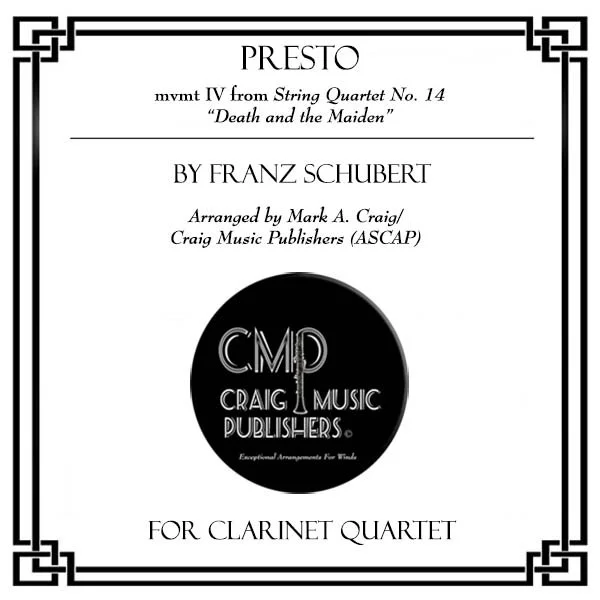
This year, I will complete my arrangement of this entire string quartet transcription. I started with the “Presto” (mvmt. IV), then arranged the “Scherzo” (mvmt. III). I took a break before completing the set. But, next, I will tackle the “Andante con moto” (mvmt. II) before completing the set with the “Allegro” (mvmt. I). What is your favorite string quartet? Do you have a favorite transcription? CMP is interested in your feedback. Please share your ideas and thoughts about this in the comments below.
By the way, have you performed any of our CMP arrangements? If so, we would greatly appreciate it if you could leave a review. Click here to leave a review on Google or click here to leave a review on my CMP YouTube Channel. If you have posted a YouTube video of a CMP arrangement, do not forget to tag us on your channel, and we will tag you back. Thanks so much! Happy practicing!
Before we continue, here are three music trivia questions on Schubert to challenge you; I will reveal the answers towards the end of this blog post. I hope you enjoy them.
First, which modern American composer incorporated the second-movement theme from Schubert’s “Death and the Maiden” String Quartet into one of his more popular compositions?
Second, which diabolical dance form is Schubert’s “Presto” modeled after?
And third, which human characteristic, that aided Schubert in completing his iconic string quartet, did he call “thou greatest treasure of man, thou inexhaustible wellspring from which artists as well as savants drink?”
Tell me your answers in the comments below, or feel free to share any other interesting musical facts you might know about Schubert or this amazing composition. Now, let’s continue with the topic at hand.
Challenges in Arranging for Clarinet Quartet
Writing musical notes on staff paper
Whenever I write an arrangement for clarinet quartets, there are several things to take into consideration: the technical challenges of the music, the attempt to achieve a good dynamic contrast within the parts, a painstaking, keen attention to detail, the proficiency and breath capacity (playing longevity) of the individual players, the struggle to achieve a perfect balance between the players taking into account the timbre and range of each instrument, the choice of whether to use Eb clarinet or alto clarinet in the arrangement, and so on. These are just a few of the challenges arrangers face when writing for a clarinet quartet. CMP arrangements are designed to address these issues, resulting in well-written, well-balanced works.
CMP arrangements offer equally balanced parts, mainly because I came from the Air Force Band world, where the quality of musicians was incredibly high, and therefore, each player deserved a challenging part. Many published arrangements do not offer this option, as they are written for educational purposes, with junior high or high school band students in mind, each with widely varying levels of proficiency. By writing well-balanced parts, CMP keeps all players happy by distributing melody, counter melody, technical passages, and support passages. That is why so many musicians comment that Mark A. Craig's arrangements are fun to play.
Another key feature of CMP arrangements is that they are created with players in mind; therefore, we provide a good number of breaks for each player, so that parts are not too taxing. It is important to offer players challenging parts, but also with adequate breaks to maintain both mental and physical stamina. We also strive to include good page turns so that individual players do not have to tape their parts together to make page turns work. Nothing is more frustrating than bad page turns, which can add more stress to a performance. Although these might seem like minor features of an arrangement, they all add up to better quality arrangements and happier players.
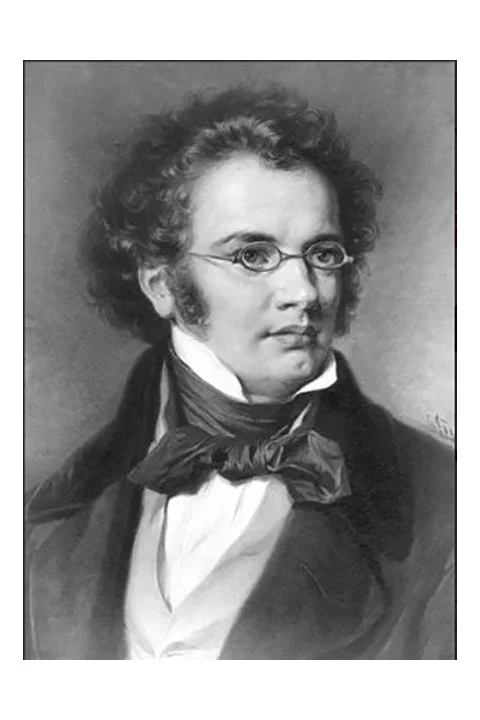
Here is a striking photo of Schubert I found in an Arts Journal Blog post entitled:
Schubert Uncorked
December 17, 2017 by Joe Horowitz
Schubert: “Presto” - for CLarinet Quartet
This challenging and dynamic, advanced intermediate mixed clarinet quartet digital download arrangement of Franz Schubert's "Presto," mvmt IV from his String Quartet No. 14, "Death and the Maiden," is perfect for recitals, contests, competitions, background dinner music gigs, weddings, educational outreach, and formal events. This transcription of a Romantic Era work was written for the most advanced ensembles, from college groups to professional quartets, and is scored for Eb clarinet, two Bb clarinets, and bass.
To address the challenges I mentioned earlier, the main technical challenge was the range, which led me to employ the extended range of an Eb clarinet, since I am not a huge fan of the “ultra-altissimo” Bb clarinet. Secondly, D minor is a relatively easy key for clarinets, so it presented no arranging hurdles. As for achieving good dynamic contrast, I included all of Schubert’s original dynamic markings, of which there are many. This Schubert masterpiece is filled with abundant dynamic contrast. As death is a predominant theme in this entire quartet, drama is not in short supply thanks to Schubert’s electrifying score.
As always, keen attention to detail is important at CMP; therefore, I performed several editing passes to verify the accurate use of text, symbols, lines, layout, and formatting. Regarding the players' breath capacity, I included accessible page turns for all members of the group. Finally, to achieve a good balance between the parts, an arranger must make orchestration decisions based on the timbre, range, and capabilities of each instrument. Nearly 25 years of arranging experience help me make the right compositional decisions to create an exceptional arrangement. The final product works quite well for clarinet quartet.
This rondo-type movement opens in D minor and has two main themes that repeat a few times each. The first theme features unisons, octaves, and running triplets. The second theme is chorale-like and quotes another Schubert work: "Erlkönig" Op. 1, D 328, written in 1815. The work closes with a Prestissimo coda beginning in D major, but ultimately returning to D minor with a turbulent, devilish, frantic conclusion. This diabolical tarantella, also known as the “dance of death,” includes sudden dramatic shifts from fortissimo to pianissimo and abrupt changes in tone from the lyrical to the dramatic. Therefore, it is important to exaggerate all articulations and dynamics in this piece. Originally scored for string quartet, I hope you enjoy this unique setting for clarinets.
This masterpiece of chamber music has become extremely popular in the repertoire, delighting audiences all over the world. According to the Carnegie Hall website, Schubert’s String Quartet No. 14 “Death and the Maiden” has been the most-often performed string quartet in Carnegie Hall history, with 56 performances.
Carnegiehall.org. (n.d.). The Five Most-Often Performed String Quartets at Carnegie Hall. Carnegie Hall. https://www.carnegiehall.org/explore/articles/2021/07/22/the-five-most-often-performed-string-quartets-at-carnegie-hall
Where can I buy digital download sheet music arranged for clarinet quartet? Woodwind quartet? Clarinet quintet? Woodwind quintet? Clarinet choir?
Craig Music Publishers!
Support a veteran-owned business and give your audiences an evening of great music with high-quality, expertly hand-crafted arrangements by purchasing digital downloads in our Shop, organized by ensemble type.

music trivia questions
First question: Which modern American composer incorporated the second-movement theme from Schubert’s “Death and the Maiden” String Quartet into one of his more popular compositions?
American avant-garde contemporary-classical-music composer George Crumb incorporated Schubert’s second-movement theme into the Pavana Lachrymae of his own string quartet, Black Angels. Crumb summarized his work thus,
"Black Angels (Thirteen Images from the Dark Land) was conceived as a kind of parable on our troubled contemporary world. The numerous quasi-programmatic allusions in the work are therefore symbolic, although the essential polarity – God versus Devil – implied more than a purely metaphysical reality. The image of the "black angel" was a conventional device used by early painters to symbolize the fallen angel.”
Wikipedia contributors. (2025, August 23). Black Angels (Crumb). In Wikipedia, The Free Encyclopedia. Retrieved 19:15, March 16, 2026, from https://en.wikipedia.org/w/index.php?title=Black_Angels_(Crumb)&oldid=1307374539
Second question: Which diabolical dance form is Schubert’s “Presto” modeled after?
Schubert modeled this final movement from his grand string quartet after the devilish Italian tarantella, also known as the “dance of death.” American composer Jonathan Blumhofer discusses the tarantella and the “Presto”, as:
“…a dance that depicts the frenzied madness and death resulting from a tarantula bite (Mendelssohn used the same form in the finale of his Fourth Symphony). This is some of the most explosive music Schubert wrote, by turns spastic, demonic, reflective, and just plain weird. Of particular note is the grace note hiccup that serves to provide the opening tarantella theme an added jolt of energy and to emphasize several transitions that occur in rhythmic unison throughout the movement.”
Schubert – String Quartet in D minor, “Death and the Maiden.” Jonathan Blumhofer. (2017, July 21). https://www.jonathanblumhofer.com/writings/program-notes/schubert-string-quartet-in-d-minor-death-and-the-maiden/
Third question: Which human characteristic, that aided Schubert in completing his iconic string quartet, did he call “thou greatest treasure of man, thou inexhaustible wellspring from which artists as well as savants drink?”
Although Schubert was in the tertiary stage of his illness, and could feel death closing in on him, he composed both the A minor quartet “Rosamunde’ and the D minor quartet “Death and the Maiden,” two of his greatest works, thanks to the human characteristic, imagination. March, 1824:
“In response to his despair, he [Schubert] kept an occasional journal; writing in March, he appealed to the one thing whose loss would be even more devastating than his physical afflictions: ‘O imagination! Thou greatest treasure of man, thou inexhaustible wellspring from which artists as well as savants drink! O remain with us still, by however few thou are acknowledged and revered…’”
Winter, R., Brown, M., & Sams, E. (2001). Schubert, Franz (i). Grove Music Online. Retrieved 16 Mar. 2026, from https://www.oxfordmusiconline.com/grovemusic/view/10.1093/gmo/9781561592630.001.0001/omo-9781561592630-e-0000025109.
Thanks for taking the time to stop by and read my blog. I hope you enjoyed my musings on music. I will be back in two weeks with more anecdotes, memories, and passions for music. In the meantime, you can listen to my arrangement of Schubert’s “Presto” from String Quartet No. 14 “Death and the Maiden” D810 for clarinet quartet by clicking on the MP3 player below. Then click here to purchase it from our Shop. If you have not yet spoken up, tell me in the comment section below what your favorite string quartet is, which transcriptions you fancy, or which arrangements you might be interested in seeing on CMP. I’d love to hear about it. Thanks for stopping by. See you in my next blog!
20 March 2026

Schubert: Cover art for “Presto” from String Quartet No. 14 “Death and the Maiden” - for Clarinet Quartet
