
Blog Post 8
rossini: overture to Italian in Algiers - for clarinet choir
Thanks for stopping by, and welcome to my blog! I hope you had a fantastic week. Where can I purchase digital sheet music for clarinet choirs online? Craig Music Publishers! As a matter of fact, in this blog post, I will be discussing the inspiration for my new clarinet choir arrangement of Gioacchino Rossini’s Overture to Italian in Algiers. Rossini wrote some wonderful opera overtures. This one is my favorite. Which one is your favorite? There are so many good choices! Tell me about it in the comments below.
Let’s start this week’s blog post with a new feature. I will ask a few questions about this week’s feature piece and will post the answers towards the end of this blog post. First, how old was Rossini when he wrote the Italian in Algiers Overture? Second, which symphony, written by a famous Austrian composer, did Rossini emulate in this overture? And third, what is interesting or unique about Rossini’s birthday? Tell me your answers in the comments below, or feel free to share any other interesting facts you might know about this iconic overture.
I first heard this Rossini overture in high school. Our Texas Region III All-Region Band played this overture during my junior year, along with music by Grainger, Chance, and Milhaud. This was the first Rossini overture I had ever heard, and I immediately fell in love with it. I was a bass clarinetist until my senior year in high school, and played principal bass on this concert. I remember the Rossini being challenging (especially the Bb parts), but fun. Years later, when I was stationed in Germany with the U.S. Air Forces in Europe Band (USAFE Band), our Deputy Commander took a group of us on a concert tour of eastern Germany as a large woodwind chamber ensemble. For this tour, I wrote a transcription of Overture to Italian in Algiers for our large chamber ensemble. The piece was very well-received, and our group really enjoyed performing it. Below is a picture from that tour of our Chamber Winds Ensemble performing at the Coudraysall der Musikschule in Weimar, Germany.
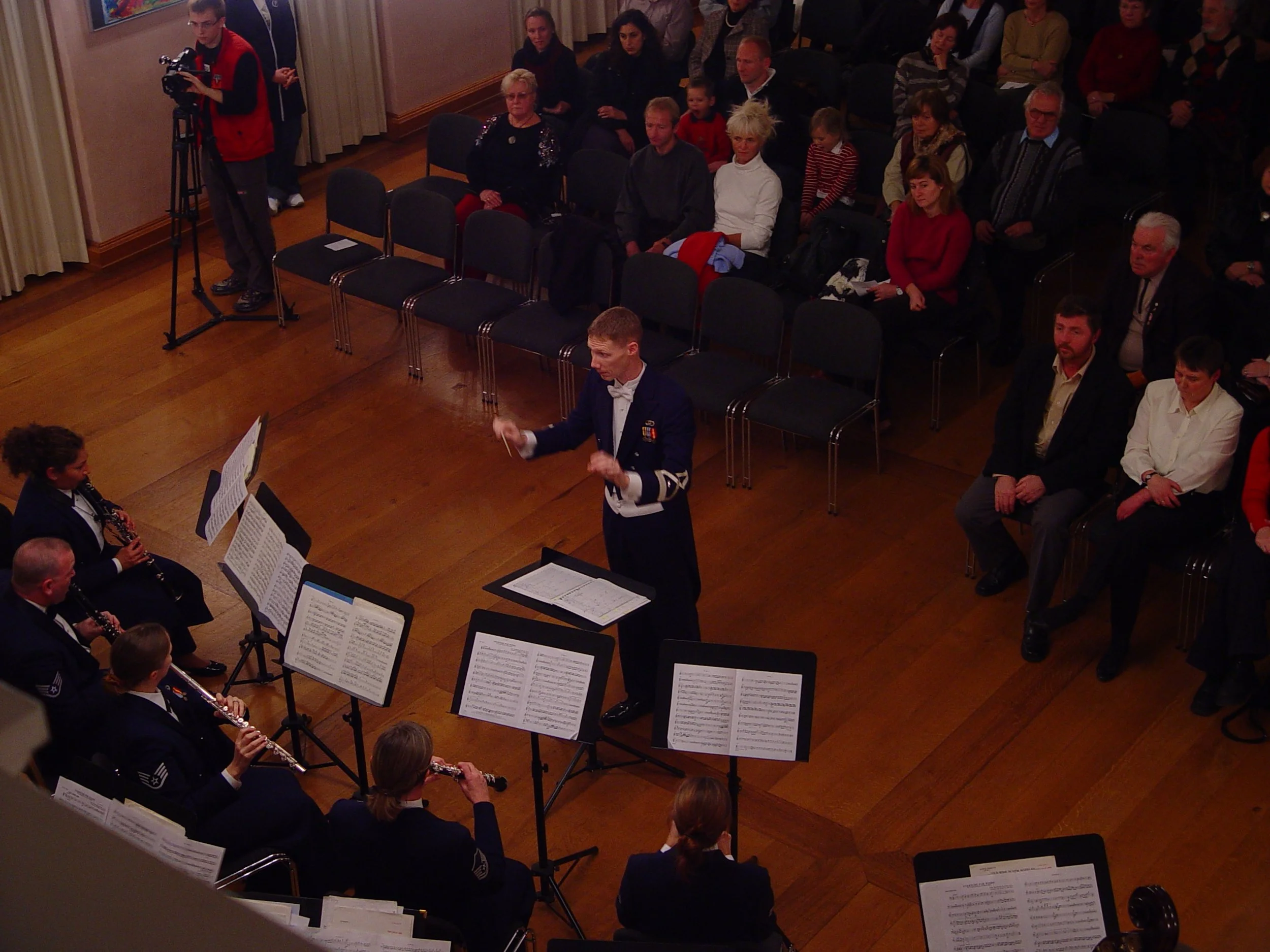
The USAFE Band Chamber Winds Ensemble performing in Weimar, Germany
It is a bit rare for military bands to have the opportunity to perform chamber music with a large chamber ensemble. Most of our concert tours involve either our large concert band or one of our small ensembles, such as a clarinet quartet or woodwind quintet. It was a treat to perform with a large chamber ensemble, playing pieces like the Strauss “Serenade,” Mendelssohn’s “Overture for Winds,” this Rossini overture, and Handel’s “Arrival of the Queen of Sheba,” from his oratorio Solomon (which I have arranged for clarinet choir; click here to purchase it). These Chamber Winds concert tours were always musically rewarding, plus they gave us a unique opportunity to serve as musical ambassadors for the U.S. Air Force, building bridges and forging friendships between the United States and diverse populations across Europe, and demonstrating our professionalism and musical excellence to these German citizens.
Later, when I was looking for a new arranging project for clarinet choir, it was an easy decision to revisit my large chamber ensemble arrangement of Rossini’s Overture to Italian in Algiers and transcribe it for a clarinet ensemble. Clarinets have an excellent range and dynamic contrast, so it was natural to transcribe this large chamber work for a clarinet choir. Writing for Bb clarinet is a breeze, but writing for Contra Alto Clarinet and Alto Clarinet can be challenging sometimes; however, they both add a unique color and timbre to the ensemble. The Eb clarinet, with its whimsical and dynamic qualities, extends the range of the Bb clarinet and also adds quite a unique color and timbre to the ensemble. Additionally, I enjoy adding optional percussion to certain pieces when the original work has prominent percussion parts. I believe this enhances the ensemble's marketability. This delightful clarinet choir transcription of Overture to Italian in Algiers, with its technical fireworks and beautiful melodies, will continue to enchant and delight its audiences in this new setting for winds.
OK. Here are the answers to the Rossini questions I posted at the beginning of the blog.
First, how old was Rossini when he wrote the Italian in Algiers Overture?
Rossini wrote this overture in 1813, when he was only 21 years old.
Second, which symphony, written by a famous Austrian composer, did Rossini emulate in this overture?
Rossini mimicked Franz Joseph Haydn’s Surprise Symphony in the opening measures of this iconic overture.
And third, what is interesting or unique about Rossini’s birthday?
He was born in a leap year, on 29 Feb 1792. Because he was born on a leap day, he only officially celebrated birthdays every four years.
Thanks for taking the time to stop by and read my blog. I hope you enjoyed my musings on music. I’ll be back next week with more anecdotes, memories, and passions for music. In the meantime, you can listen to my arrangement of this delightful overture by clicking on the MP3 player below, and then click here to purchase it from my Shop. What are your experiences with this Rossini overture? Have you played this in orchestra, concert band, or a small ensemble? Tell me all about it in the comments below. I’d love to hear your story about how the Rossini has affected your life. Thanks for stopping by. See you in my next blog!
12 December 2025

Rossini: Overture to Italian in Algiers - Arranged for Clarinet Choir - cover art
